Vietnam Device Registration: Reference Approval, Then 10 Working Days
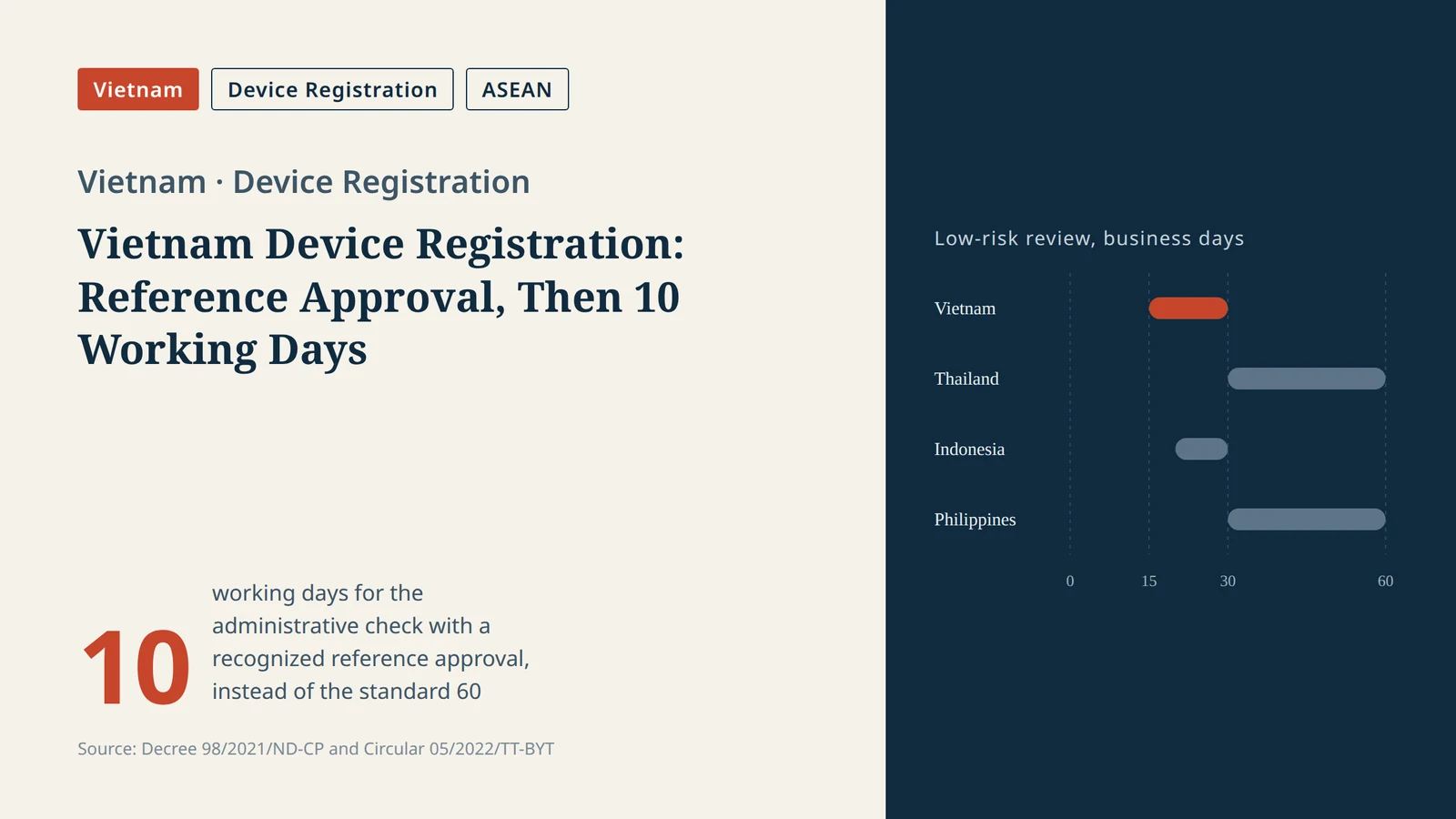
If the device already has a marketing approval from a regulator Vietnam recognizes, the Ministry of Health can waive the technical review and check the file administratively. That check takes 10 working days instead of the standard 60.
On this page
- Which approval opens the fast route
- Announcement or registration number
- Set the class before you pick the door
- What the 10 days do not cover
- What the technical file contains
- Whether the market supports the effort
- After the number: each shipment, then changes
- Where Vietnam sits among four ASEAN markets
- Where applications and launches fail
- Look it up on MedRegData
- References
Search in MedRegData
If the device already has a marketing approval from a regulator Vietnam recognizes, the Ministry of Health can waive the technical review and check the file administratively. That check takes 10 working days instead of the standard 60. A Class C or Class D registration number, once issued, has no fixed expiry, so you do not renew it every 5 years the way you do in Thailand, Indonesia and the Philippines.
The 10 working days are the review, not the whole project. Label translation, the authorized representative, the importer's qualifications, document preparation and legalization of the free-sale certificate all sit outside those 10 days. If that preparation is already underway, the fast route can finish in 1–2 months. A standard Class C or Class D registration takes 3–12 months.
Which approval opens the fast route
The current rules are Decree 98/2021/ND-CP, issued on November 8, 2021, in force from January 1, 2022. It replaced Decree 36/2016/ND-CP from 2016. Decree 07/2023/ND-CP amended some of its provisions. Circular 05/2022/TT-BYT, issued in 2022, sets out the implementing detail and replaced Circular 39/2016/TT-BYT. The circular was issued on August 1, 2022.
The fast route is the reference-country provision in Decree 98. If the product is already approved for marketing in a country or region Vietnam recognizes, the Ministry can drop the technical review and do an administrative check only.
| Reference country or region | Authority |
|---|---|
| China | NMPA (National Medical Products Administration) |
| South Korea | MFDS |
| Japan | PMDA/MHLW |
| United States | FDA |
| EU | Notified body |
| Australia | TGA |
| Canada | Health Canada |
A home-market approval works for this route when the authority that issued it is on that list. If it is not, you are on the standard Class C or Class D timeline of 3–12 months.
Holders of an NMPA registration or filing certificate can use the route directly, and four conditions apply. The certificate must be a valid registration or filing issued by the NMPA. You submit a notarized and legalized copy, with a Chinese translation. The specifications and models declared in Vietnam must match the NMPA certificate. Vietnamese labeling, language and authorized-representative requirements still have to be met.
Announcement or registration number
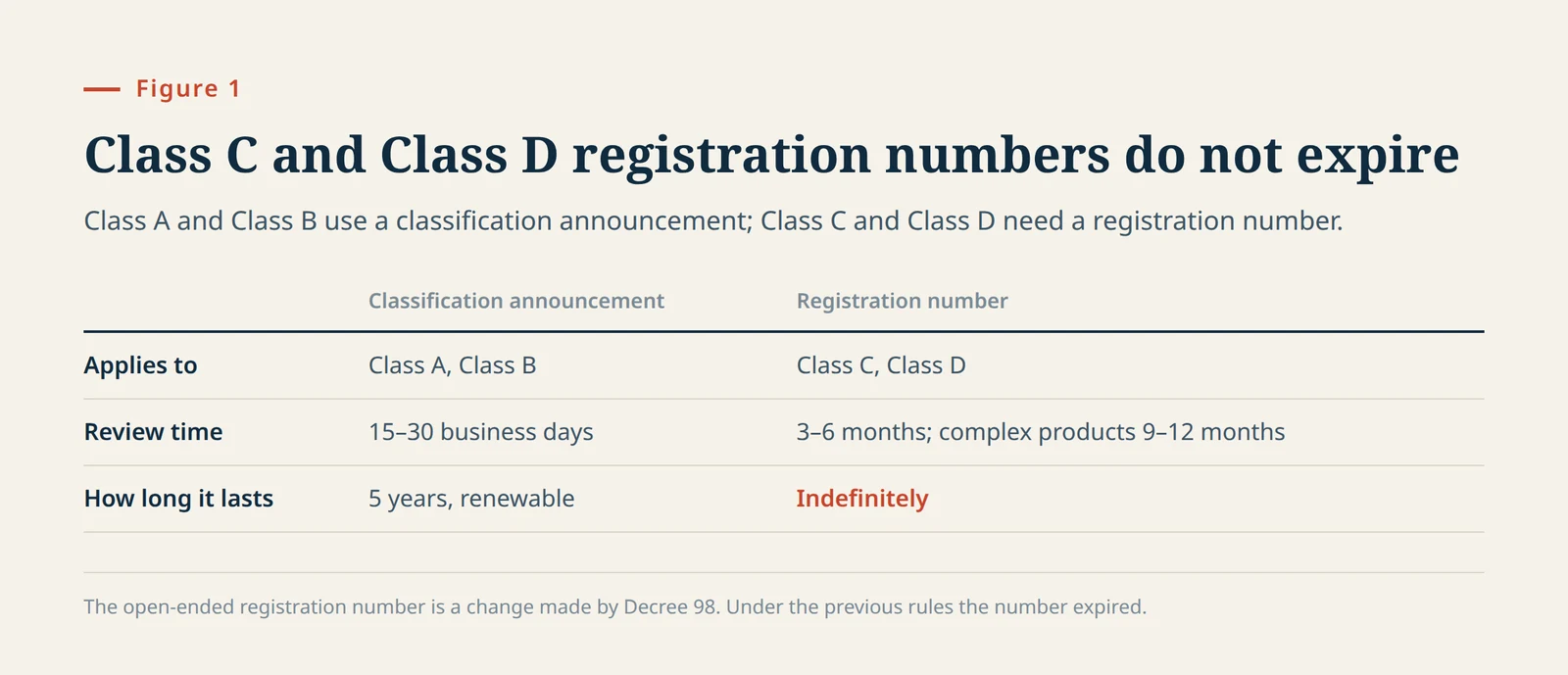
Vietnam uses four classes, A through D, from low risk to high. Class A and Class B use a classification announcement: a notification, checked mainly for form. Class C and Class D need a registration number: a technical review, item by item, with a full CSDT technical file and a clinical evaluation report.
| Classification announcement | Registration number | |
|---|---|---|
| Applies to | Class A, Class B | Class C, Class D |
| Who approves | Ministry of Health electronic platform | Department of Medical Equipment and Health Engineering, Ministry of Health |
| Review time | 15–30 business days | 3–6 months; complex products 9–12 months |
| How long it lasts | 5 years, renewable | Indefinitely |
The open-ended registration number is a change made by Decree 98. Under the previous rules the number expired. That fixed term is gone. The duty to stay compliant is not. In Thailand, Indonesia and the Philippines, a high-risk registration lasts 5 years.
Government fees are the small part of the budget. Most of the spend is the agent, translation, notarization and clinical evaluation.
| Cost | Class A / Class B | Class C / Class D |
|---|---|---|
| Government fees | About 3–5 million Vietnamese dong (about $130–$220) | About 5–15 million Vietnamese dong (about $220–$650) |
| Agent | $2,000–$4,000 | $5,000–$15,000 |
| Clinical evaluation, if required | Usually not required | $2,000–$8,000 |
| Total budget | $3,000–$6,000 | $10,000–$30,000 |
Document preparation takes 1–2 months for Class A and Class B, and 2–4 months for Class C and Class D. Notarization and certification take 2–4 weeks on both the low-risk and the high-risk path. If the authority asks for more documents, add 1–2 weeks for Class A and Class B, and 1–3 months for Class C and Class D. End to end, low-risk products take 2–4 months and high-risk products take 6–12 months.
Set the class before you pick the door
Classification follows Annex 2 of the ASEAN Medical Device Directive (AMDD) and the principles of the GHTF, now continued by IMDRF. Six factors set the class: contact time, degree of invasiveness, site of contact, whether the device is active or passive, the type of energy, and whether it contains a medicine or material of animal origin. Contact time has three bands: brief, less than 60 minutes; short-term, less than 30 days; long-term, more than 30 days.
| Class | Risk | Close to the EU | Close to the US FDA | Path |
|---|---|---|---|---|
| Class A | Lowest | Class I | Class I | Classification announcement |
| Class B | Low to medium | Class IIa | Class II | Classification announcement |
| Class C | Medium to high | Class IIb | Class II / Class III | Registration number |
| Class D | Highest | Class III | Class III | Registration number |
Common placements: medical masks, bandages and examination gloves are Class A. Disposable syringes and infusion sets are Class B. Hemodialyzers and ventilators are Class C. Pacemakers and artificial joints are Class D. Patient monitors, diagnostic ultrasound and clinical chemistry analyzers are Class B.
In vitro diagnostic reagents use the same frame. General laboratory equipment is Class A. Clinical chemistry and hematology analyzers and reagents are Class B. Blood-grouping reagents and tumor markers are Class C. HIV, HBV and HCV test reagents, and blood screening, are Class D.
Spend the extra day on the class. A product that only needs an announcement, but is put through full registration, wastes months. A product that needs a registration number, but only receives an announcement, is treated as unlicensed once it is on the market.
What the 10 days do not cover
The review can be shortened. The documents and the local party cannot.
Free-sale certificate and legalization. Imported devices need a free-sale certificate from the competent authority of the country of origin. It is valid for 2 years from the date of issue, and it has to be renewed when it expires. Certificates used in practice include an export sales certificate from the NMPA, an export certificate from the drug regulator of some provinces in China, and, for a device that already carries CE marking, a certificate issued by an EU member state.
The certificate itself is the easier part. Legalization is the hard part. It is notarized in the country that issued it, then authenticated by that country's ministry of foreign affairs, then legalized by the Vietnamese embassy or consulate in that country. A power of attorney goes through the same chain. A file that misses this legalization is one of the most common reasons an application is sent back. Start it early.
Documents issued in China follow that chain locally: a Chinese notary, then the Consular Department of China's Ministry of Foreign Affairs, then the Vietnamese embassy or consulate in China. That chain usually takes 4–8 weeks.
Vietnamese labels and instructions. A device sold in Vietnam needs a Vietnamese label: product name, intended use, the Vietnamese importer's name and address, and storage conditions. The country of origin must be stated in Vietnamese. The registration number or announcement number is printed on the label. The date of manufacture must appear. Where they apply, so do the expiry date, the sterilization method and a single-use statement.
The instructions for use must be a complete Vietnamese text. A complex device may use a bilingual text, but Vietnamese has to be in it. Cover the description and intended use, installation and use, maintenance and calibration, warnings, precautions and contraindications, troubleshooting, and technical parameters and specifications. Prepare the labeling while you register. A Vietnamese label can be added to the label you already use. Use a translator in Vietnam with a medical background, and have the Vietnamese partner review the label before you file.
A Vietnamese importer. A foreign manufacturer cannot register a device in Vietnam in its own name. Every imported device is registered and imported through a Vietnamese company that holds a valid business license. That company must be a legal entity registered in Vietnam, hold a license to operate in medical devices, have warehouses that meet storage requirements, and have at least one quality manager with a background in medicine, pharmacy or engineering.
The power of attorney should state the full legal details of both parties, the scope of the authorization, the products covered, how long the authorization lasts, whether it is exclusive, the obligations of each party, and how it ends. If those terms are incomplete, the authority will ask for a new document, and that document goes through legalization again.
When you choose the partner, registration experience comes first. Prefer a company that has registered similar products. Distribution reach, warehousing and logistics, attention to compliance, and technical service come next. Financial strength comes after those, but the partner still has to be able to carry the cost of the registration period.
What the technical file contains
Class C and Class D dossiers follow the CSDT, the Common Submission Dossier Template set by the AMDD. It has seven chapters. Vietnam accepts the CSDT format. Labels and instructions still have to be in Vietnamese, and the risk analysis has to be reported to ISO 14971.
Class A and Class B need 10 documents, including the application form, a technical description, a list of applicable standards, an ISO 13485 certificate, the free-sale certificate, Vietnamese label samples and instructions, the power of attorney, the importer's business license and product photos. Class C and Class D need 15 documents. Added to the file are a complete CSDT, a clinical evaluation report, a risk-management report, and, where the product requires them, biocompatibility, sterilization, electrical safety, EMC and software verification reports. The power of attorney and the importer's qualification documents also have to be notarized and consular-legalized.
The quality system is ISO 13485. Holding it is recommended for Class A, strongly recommended for Class B, and required for Class C and Class D. Class C may be asked for a review report. Class D may be asked for a factory audit.
A factory inspection is not routine. The Ministry of Health uses it mainly in four situations: a Class D device, frequent adverse events, a first registration, or doubts about the quality system. A company already registered in another ASEAN country can reuse the same CSDT and update only the parts that are specific to Vietnam.
Whether the market supports the effort
The 2025 market is estimated at $3 billion–$3.5 billion, growing 10–12% a year, and around $5 billion–$5.5 billion by 2030. Over 90% of devices are imported.
Vietnam has nearly 100 million people, 15th in the world, and a median age of 31. There are about 1,500 public hospitals, around 300 private hospitals and approximately 35,000 clinics. Hospital beds are around 320,000, about 3.2 beds per thousand people, with 0.8 doctors per thousand people. About 100 hospitals at provincial level or above are concentrated in Hanoi and Ho Chi Minh City.
Five things are driving demand. Health coverage has reached 92%, and the government aims for full coverage by 2030. Public hospitals invest billions of dollars each year in expansion and equipment. Private chains such as Vinmec and Thu Cuc are expanding quickly. People aged 60 and over are 12% of the population, expected to reach 17% by 2030. RCEP and CPTPP have lowered tariff barriers, and foreign-invested medical projects have increased.
Import share by source country:
| Source | About this share | Typical products |
|---|---|---|
| Japan | 22% | Endoscopes, CT scanners, precision instruments |
| China | 15–18% | Medical consumables, monitoring equipment, IVD reagents |
| United States | 12% | High-end imaging and cardiovascular devices |
| Germany | 10% | Surgical equipment, dental instruments |
| South Korea | 7% | Aesthetic equipment, dental instruments |
China is the second-largest source, and that share is still growing at over 20% a year. Mindray, Wandong Medical and Libang Instruments continue to expand in Vietnam.
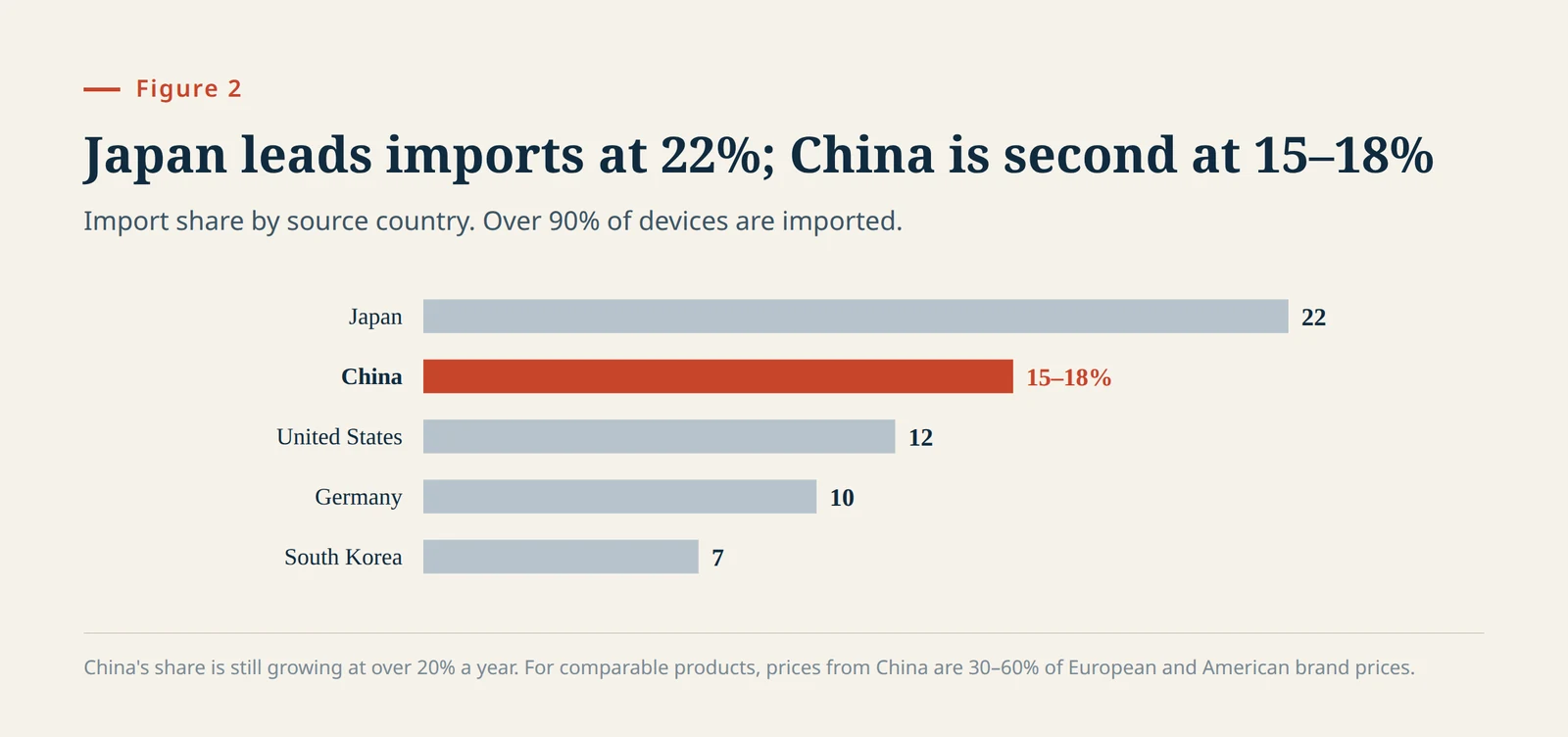
For comparable products, prices from China are 30–60% of European and American brand prices. Land delivery takes 3–5 days. Products from China can also use the tariff treatment under RCEP and the China–ASEAN free trade agreement.
E-commerce is a second channel. Vietnam's e-commerce is expected to exceed $20 billion in 2025, with the fastest growth rate in Southeast Asia. Shopee leads, Lazada follows, TikTok Shop is rising quickly, and Tiki and Sendo are local platforms. Home-use devices are among the fastest-growing categories online, with strong demand for electronic blood pressure monitors, glucose meters and test strips. Online sales follow the same rules as offline sales. The device still needs a registration number or an announcement number. The seller needs a business license. Some high-risk devices cannot be sold directly to consumers online.
On price build-up, the manufacturer's ex-factory price is 25–35% of the final price. A first-level distributor adds 30–50%. A second-level distributor adds another 20–30%. Japanese and Korean brands set the ceiling. Local and Indian products set the floor.
After the number: each shipment, then changes
The registration number or announcement number is the start of import, not the end. Each batch needs its own import permit: the certificate, then a permit for that batch, customs declaration, inspection, tariffs and value-added tax, then release into storage. A registration that lasts does not make the import permit last.
Import duty runs from 0–8%, and most lines are 0–5%. Value-added tax is 8%, against a standard rate of 10%. Medical devices receive the preferential rate. A special consumption tax is generally not charged. Customs clearance usually takes 3–5 working days. IVD reagents and other cold-chain products need temperature-monitoring records.
Under RCEP, products from China enter Vietnam at zero or low duty for most HS codes, if you present a certificate of origin (Form RCEP or Form E). HS codes used often are 9018 (medical, surgical and dental instruments), 9019 (mechanical therapy and massage devices), 9021 (orthopedic devices, artificial joints, prosthetics, hearing aids), 9022 (X-ray and radiotherapy equipment), 9027 (analytical instruments), 3822 (in vitro diagnostic reagents) and 3006 (pharmaceutical preparations).
After registration, the Vietnamese importer, as authorized representative, carries safety monitoring. Serious adverse events are reported within 10 days of discovery. General adverse events are reported within 30 days. A periodic safety report goes in once a year. The Ministry of Health can order a recall of a device that poses a safety risk. The importer notifies medical institutions, organizes the retrieval, reports how the recall was carried out, and takes corrective and preventive action.
Plan changes before you make them. A minor change to the manufacturer's address or to product specifications is a change notification and takes 1–2 months. A change of importer, or adding models or specifications, takes 2–4 months. A major design change is a new registration. For a Class A or Class B announcement, apply to renew 6 months before it expires. The renewal lasts 5 years.
Where Vietnam sits among four ASEAN markets
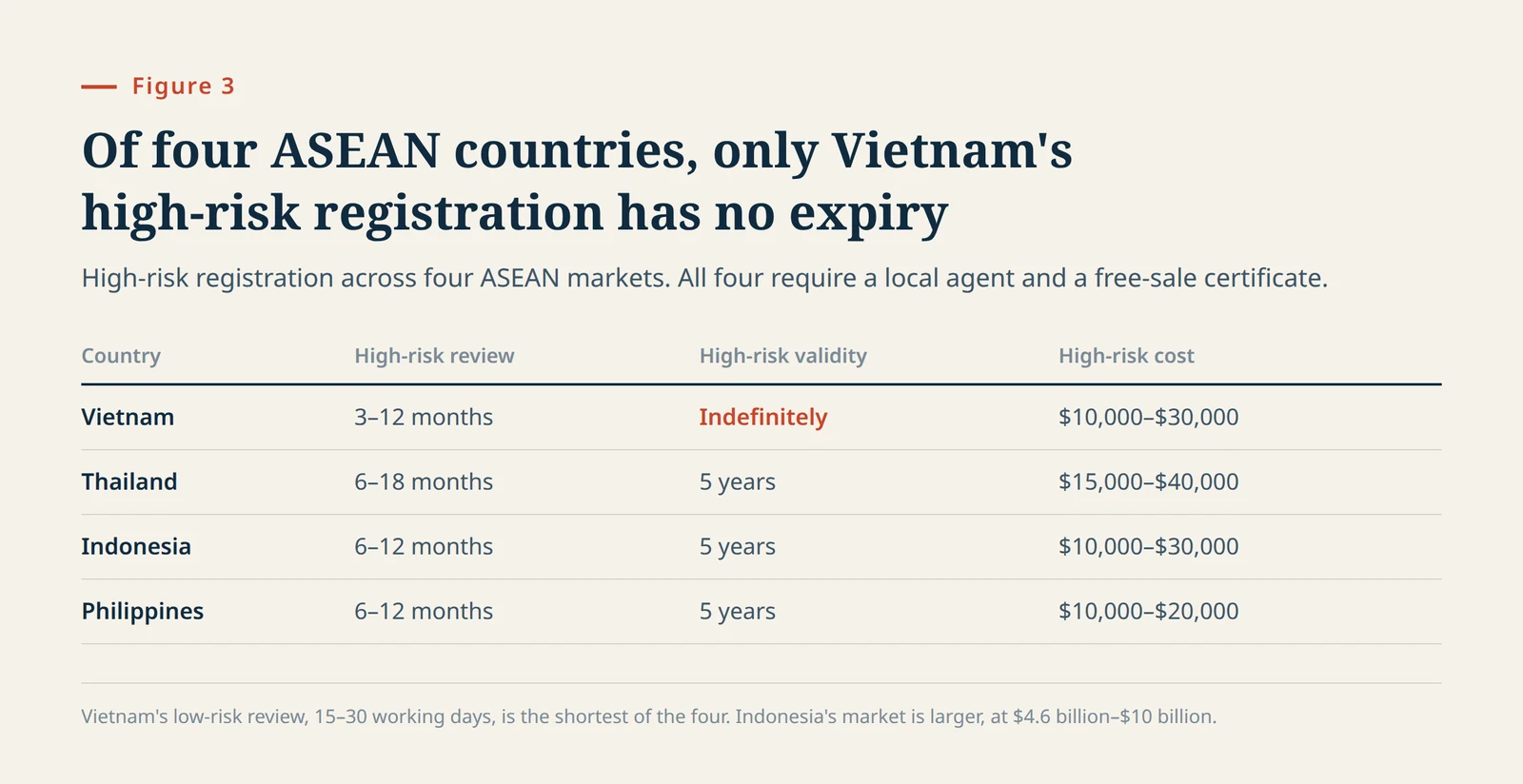
| Vietnam | Thailand | Indonesia | Philippines | |
|---|---|---|---|---|
| Core rules | Decree 98/2021 | Medical Device Act B.E. 2551 | Permenkes 62/2017 | RA 9711 |
| Classification | ABCD (AMDD) | Three classes (1/2/3) | ABCD (AMDD) | ABCD (AMDD) |
| Local agent | Required | Required | Required (PKT) | Required (CSRL) |
| Free-sale certificate | Required, with legalization | Required, with consular legalization | Required, with legalization | Required, with certification |
| Low-risk review | 15–30 business days | 30–60 business days | 20–30 business days | 30–60 business days |
| High-risk review | 3–12 months | 6–18 months | 6–12 months | 6–12 months |
| High-risk validity | Indefinite | 5 years | 5 years | 5 years |
| High-risk registration cost | $10,000–$30,000 | $15,000–$40,000 | $10,000–$30,000 | $10,000–$20,000 |
| Market size | $3 billion–$3.5 billion | About $3 billion | $4.6 billion–$10 billion | About $1.5 billion |
All four require a local agent and a free-sale certificate. Indonesia also requires Halal certification. Vietnam's low-risk review, 15–30 working days, is the shortest of the four. Its high-risk review, 3–12 months, is not slower than the others, and the registration number does not expire. For a first ASEAN market, Vietnam is the easier timeline and cost to control. Indonesia's market is larger, at $4.6 billion–$10 billion. Thailand's high-risk review, 6–18 months, is the longest of the four.
Four ways to sequence the region:
- Vietnam first, for a manufacturer entering ASEAN for the first time.
- Vietnam plus Indonesia, covering two of the fastest-growing ASEAN markets.
- Several ASEAN countries at once, using one CSDT to file in more than one country, which suits a large company with the resources.
- Vietnam as the first market, to build experience and recognition, then other ASEAN markets.
Where applications and launches fail
Five problems show up most often in registration. The free-sale certificate fails legalization, and the application is returned. The class is wrong, so the path is wrong, and both time and money are wasted. A weak Vietnamese translation delays the review or has to be redone. Clinical data are thin, and Class C or Class D is asked for more clinical evidence. The power of attorney is incomplete, so it is redrafted and legalized again.
Five problems show up after launch. A distributor signs and does not promote, so registration produces no sales. Put a minimum sales commitment and a termination clause in the agreement. Copies disrupt the market, so register the trademark and the design patent in Vietnam beforehand. Long payment terms strain cash flow. Ask new customers for payment in advance or a letter of credit. Thin after-sales support produces complaints. Build a local service team or use a third party. Missing a rule change leaves a registration expired or the company in breach. Stay in close contact with the Vietnamese agent and follow Ministry of Health notices.
A practical order of work:
- Visit in person. Use exhibitions such as Pharmedi Vietnam and Vietnam Medi-pharm, see hospitals and distributors in Hanoi and Ho Chi Minh City, and assess 2–3 possible Vietnamese agents.
- Sign the distribution agreement and the power of attorney. Start the free-sale certificate and its legalization, and prepare Vietnamese labels and instructions at the same time. File the classification announcement for Class A and Class B. Start the registration application for Class C and Class D in parallel.
- Once the number is issued, import and sell the first batch, set up after-sales support, and take part in public-hospital tenders.
- After that, register more of the product line, build a second-level distribution network, and consider a representative office or a subsidiary.
Look it up on MedRegData
Registrations mentioned here can be searched by country in the MedRegData database. The links below open the matching results; the first few pages are visible without logging in.
References
- Decree 98/2021/ND-CP, issued November 8, 2021, in force January 1, 2022; Decree 07/2023/ND-CP amended some provisions. English consolidated text: https://english.luatvietnam.vn/y-te/consolidated-document-04-vbhn-byt-management-of-medical-equipment-346414-d5.html
- Circular 05/2022/TT-BYT, implementing rules for Decree 98, issued August 1, 2022, replacing Circular 39/2016/TT-BYT: https://www.tilleke.com/insights/vietnam-issues-new-guidance-on-medical-device-regulations/
- Vietnam Ministry of Health. The Department of Medical Equipment and Health Engineering handles Class C and Class D: https://moh.gov.vn/
- ASEAN Medical Device Directive (AMDD), the regional frame for ABCD classification and the CSDT, signed in 2014 and in force in 2015. GHTF classification principles are now continued by IMDRF: https://www.imdrf.org/
- ISO 13485, required for Class C and Class D: https://www.iso.org/standard/59752.html
- ISO 14971, the risk-management standard for Class C and Class D dossiers: https://www.iso.org/standard/72704.html
- Reference authorities: NMPA https://english.nmpa.gov.cn/medicaldevices.html ; South Korea MFDS https://www.mfds.go.kr/eng/index.do ; Japan PMDA https://www.pmda.go.jp/english/ ; US FDA https://www.fda.gov/ ; EU MDR (EU) 2017/745 https://eur-lex.europa.eu/legal-content/EN/TXT/?uri=CELEX%3A32017R0745 ; Australia TGA https://www.tga.gov.au/products/medical-devices/overview/medical-devices-overview ; Health Canada https://www.canada.ca/en/health-canada/services/drugs-health-products/medical-devices.html
- Thailand, Medical Device Act B.E. 2551 (2008): https://en.fda.moph.go.th/media.php?id=516856465517060096&name=Medical%20Devices%20Act%2C%20B.E.2551%20%282008%29.pdf
- Indonesia, Permenkes 62/2017: https://asiaactual.com/wp-content/uploads/2023/03/PMK_No._62_Th_2017_ttg_Izin_Edar_ALKES_ALKES_Diagnostik_In_Vitro_dan_Perbekalan_Kesehatan_-English.pdf
- Philippines, RA 9711 (FDA Act of 2009): https://www.officialgazette.gov.ph/2009/08/18/republic-act-no-9711/