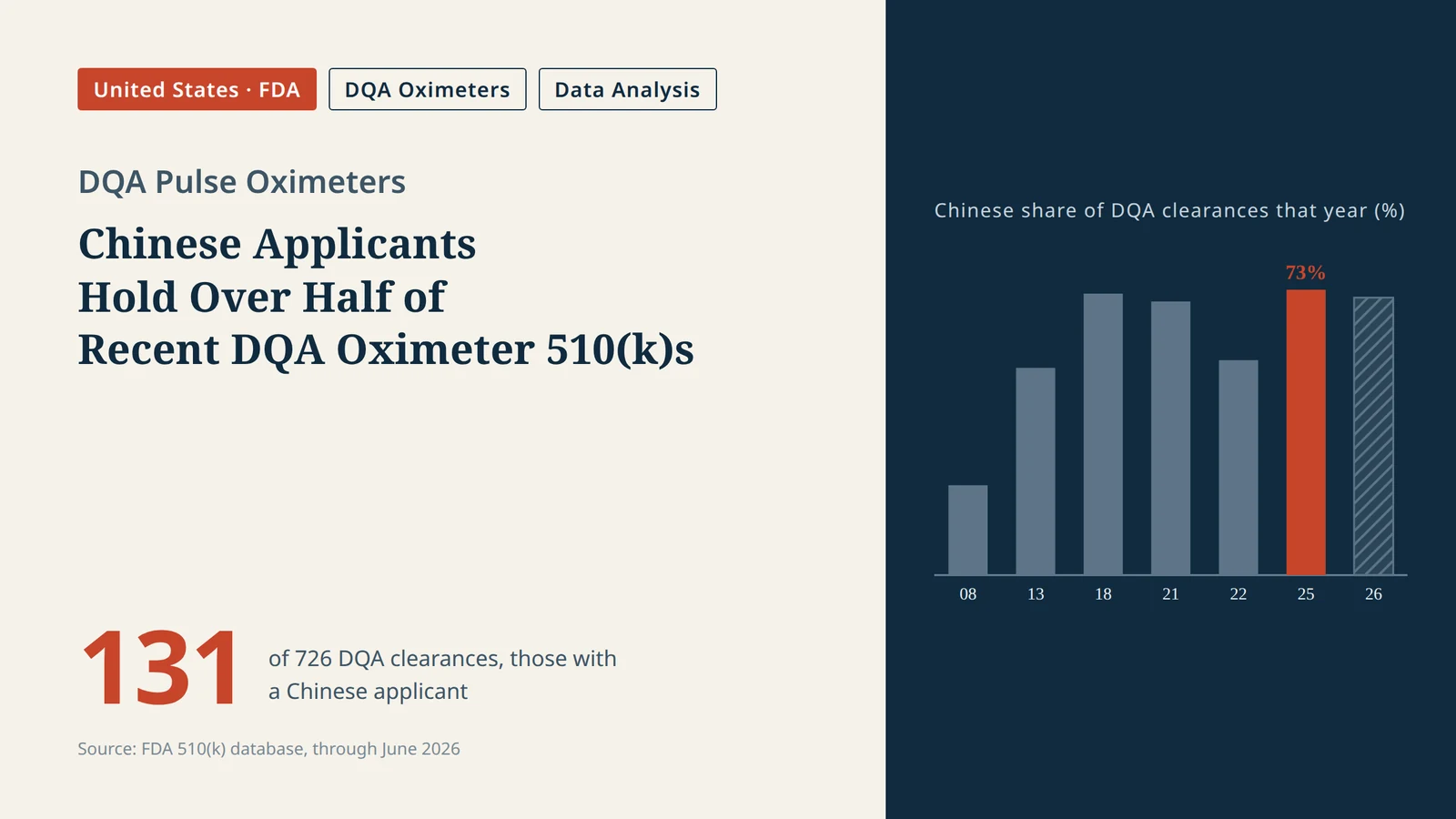
Chinese Applicants Hold Over Half of Recent DQA Oximeter 510(k)s
A new fingertip pulse oximeter from a Chinese manufacturer faces a different US path than it did five years ago. The 510(k) route is the same. What has changed sits beside it.
On this page
Search in MedRegData
A new fingertip pulse oximeter from a Chinese manufacturer faces a different US path than it did five years ago. The 510(k) route is the same. What has changed sits beside it. A draft FDA guidance would scale clinical testing up by more than ten times, and a cleared device can still be unsellable if a patent blocks it. Both constraints come from inside this product code, DQA. The clearance counts explain how Chinese applicants got here. They do not, by themselves, say a device can be bought.
A draft clinical bar, and a patent that outranks the clearance
On January 6, 2025, the FDA issued a draft guidance, "Pulse Oximeters for Medical Purposes — Non-Clinical and Clinical Performance Testing, Labeling, and Premarket Submission Recommendations," signed by Michelle Tarver, director of CDRH. It is the first major update to this guidance in more than a decade. The previous version was from 2013.
The draft traces back to a study by the Sjoding team in The New England Journal of Medicine on December 17, 2020. They compared nearly 50,000 pairs of pulse-oximeter readings with arterial blood gas results. Black patients had almost three times the rate of occult hypoxemia of white patients, about 11.4% against 3.6%. The device could show a normal SpO2 while arterial oxygen had already fallen below a dangerous level. A later Veterans Health Administration study put the rates at 19.6% for Black patients and 15.6% for white patients. On February 19, 2021, the FDA issued a safety communication on accuracy in patients with darker skin. In 2022 it held a public meeting of the anesthetic and respiratory therapy devices panel, on November 1, 2022. The 2025 draft is the third step on that line.
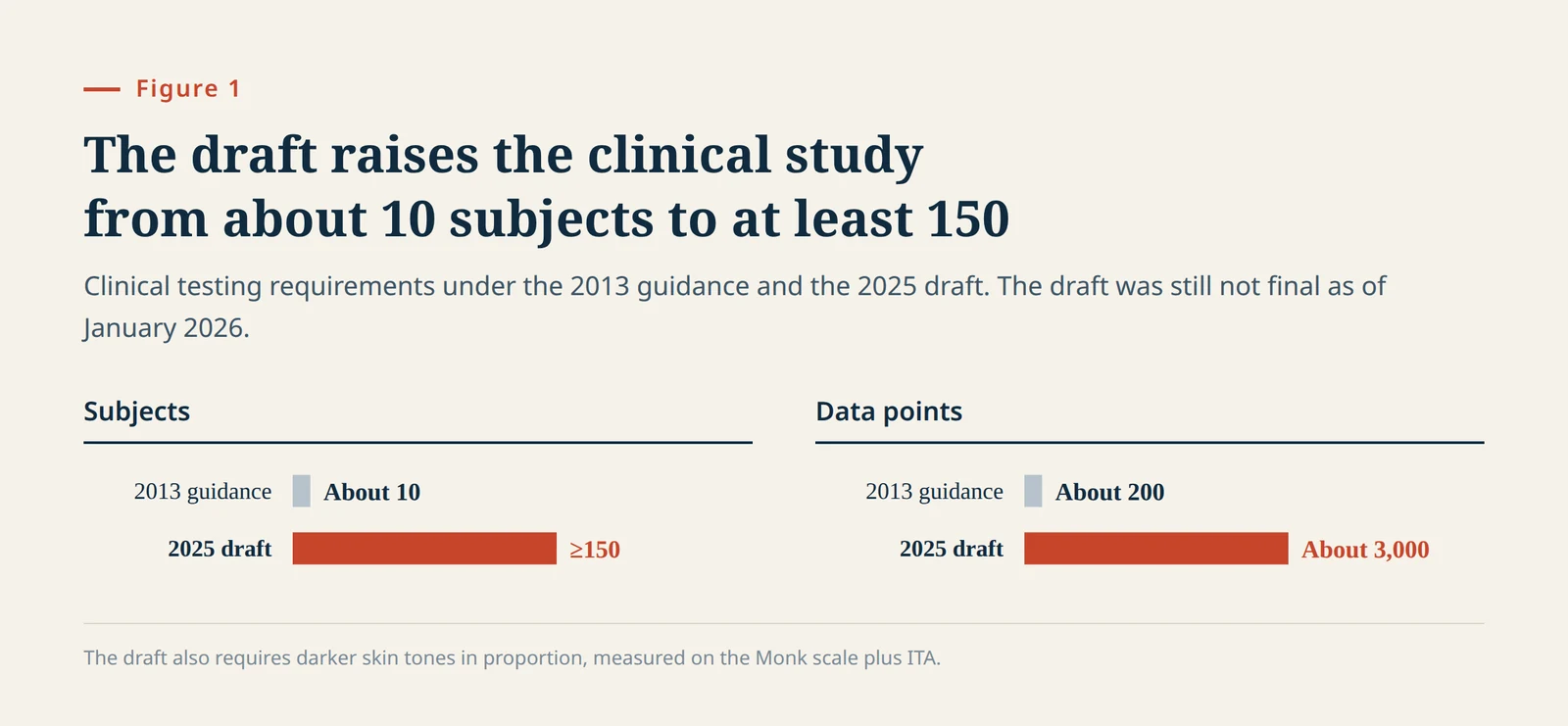
The draft lifts clinical performance testing to another scale. Subjects go from about 10 to no fewer than 150. Data points go from about 200 to about 3,000. The share of subjects with darker skin is to rise substantially, in proportion. For the first time the draft names how to measure skin tone: the Monk Skin Tone Scale together with individual typology angle (ITA), both scales used at once. The scope is not only DQA. NLF, OLK, QYU and DPZ are included.
| Test requirement | 2013 guidance | 2025 draft |
|---|---|---|
| Subjects | About 10 | At least 150 |
| Data points | About 200 | About 3,000 |
| Subjects with darker skin | "15% or 3 people, whichever is greater," and undefined | Substantially higher, balanced in proportion |
| Skin-tone measurement | Not specified | Monk scale and ITA, used together |
| Product codes | DQA and others | DQA, NLF, OLK, QYU, DPZ |
Two facts sit together. As of January 2026 the guidance is still a draft. It is not final and it is not enforceable. An FDA-funded study disclosed in early 2026 did not line up with the earlier picture. STAT's report of January 12, 2026 described that result as adding confusion. What the final text will say, and when it will take effect, is not settled. The direction is settled enough to plan against: clinical cost and time for a new clearance, and for a major change, are likely to rise.
A manufacturer that already holds a clearance has a narrower path in the draft. Leave the hardware and software alone, add clinical data that meets the new recommendations, and update the labeling. The FDA generally commits to an expedited review within 30 days. The FDA also plans a public web page of pulse oximeters whose clinical data has been checked against the new recommendations. Hospitals buying devices, and patients choosing them, would have a practical list to use.
The other constraint is patents. In December 2024, Beijing Choice and Qinhuangdao Contec ended a six-year US patent case with a settlement of $1 million. The sum is not the important term. The settlement included no patent license. If Contec wanted to keep making and selling fingertip oximeters in the United States, it had to negotiate a separate license with Beijing Choice. Without that license, it could not sell the products at issue in the US. Contec is reported to have been forced to stop making, importing and selling those products from 2018. From 2018 to 2020, legal fees alone were over 13.8 million RMB.
Three figures put that case in scale. Contec's global revenue in the third quarter of 2024 was down about 45% from a year earlier. After the settlement, the share price kept falling. The US pulse-oximeter market is about $877.4 million, about eight times the Chinese market. Contec has only 3 clearances under DQA, which does not match its visibility in cross-border e-commerce. The patent case is the main reason given. A 510(k) answers whether a product can be marketed. A patent answers whether it can be sold. They are not the same gate.
What it means for a buyer or a distributor: a DQA clearance dated before the 2025 draft was judged under the 2013 expectations. The 2025 text is not a rule yet. A name on a future FDA list would be a different signal from a clearance alone, and that list is still a plan. Separately, Contec shows that three clearances and a stopped US sale can describe the same company.
How the 131 Chinese clearances accumulated
The FDA's public 510(k) database holds 726 DQA clearances through June 2026. Of those, 131 list the applicant's country as China (CN), 18.0%. Sixty-two Chinese organizations hold them. The top 5 hold 37%. The top 10 hold half. All 131 were found substantially equivalent. None were rejected or withdrawn. By type, 116 are Traditional and 15 are Special.
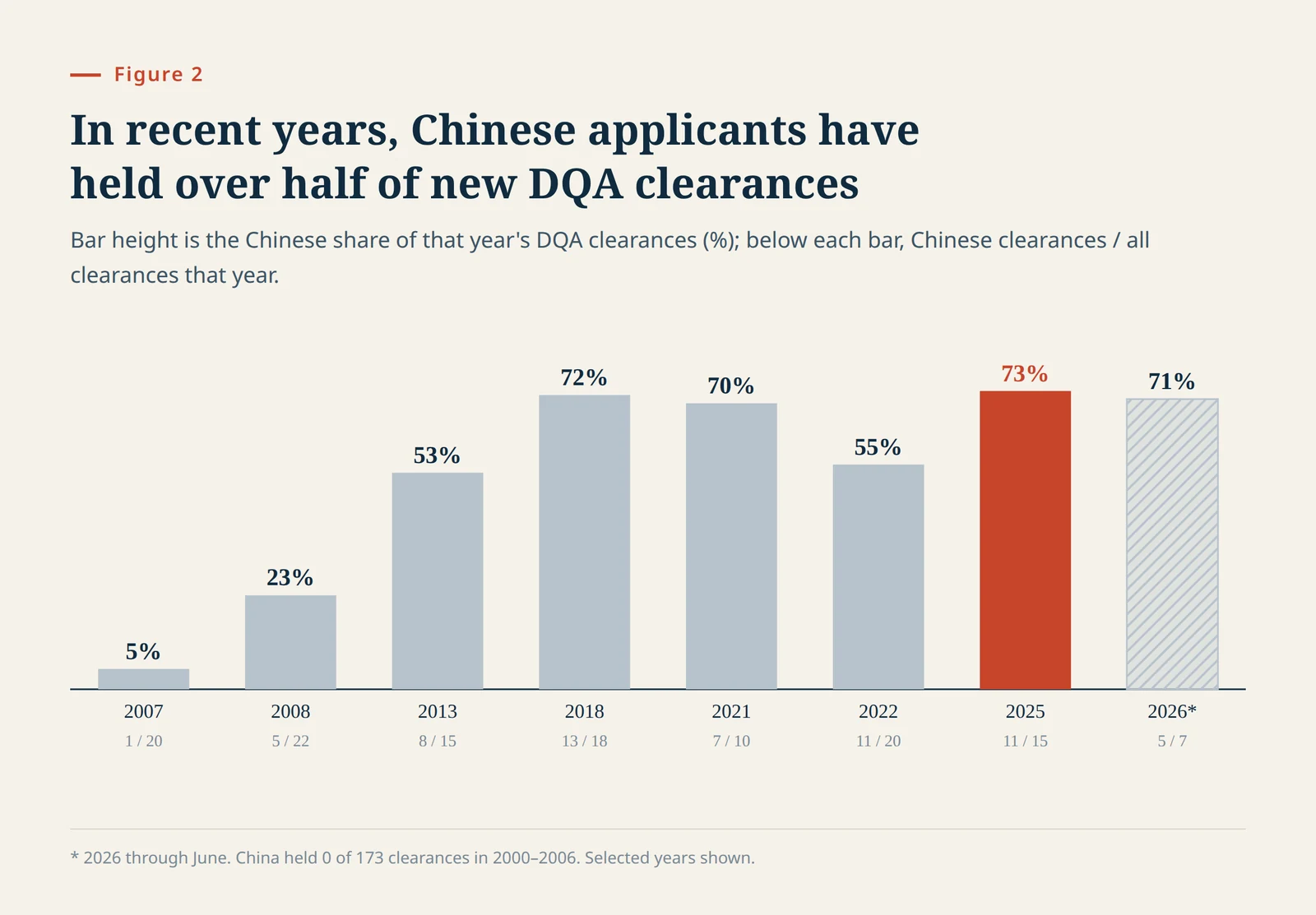
The 18.0% is easy to under-read. The denominator includes certificates accumulated over more than twenty years. The 131 Chinese records are almost all from after 2008. In new clearances over the most recent eight years or so, Chinese applicants have held over half for a long stretch.
| Year | Chinese clearances / all clearances | Share |
|---|---|---|
| 2000–2006 | 0 / 173 | 0% |
| 2007 | 1 / 20 | 5% |
| 2008 | 5 / 22 | 23% |
| 2013 | 8 / 15 | 53% |
| 2018 | 13 / 18 | 72% |
| 2021 | 7 / 10 | 70% |
| 2022 | 11 / 20 | 55% |
| 2025 | 11 / 15 | 73% |
| 2026 (through June) | 5 / 7 | 71% |
The 0% from 2000 to 2006 was not a block on Chinese applicants. In those years DQA clearances were a US set: Nonin, Masimo and Nellcor took them and built the base. Chinese applicants entered in volume from 2007 to 2008. Beijing Choice's K072825, in 2008, is the marker. By about 2013 the Chinese share had settled around 50%. The peaks have separate backgrounds. The 72% in 2018 lines up with home-use fingertip oximeters moving through cross-border e-commerce. The 73% in 2025 lines up with post-pandemic demand and with expectations around the new guidance. The source also gives 54% for 2023 and 50% for 2024, and says the share did not fall away from that level.
What it means: a competitor who quotes 18% is quoting the whole history of the code, including the years Nonin, Masimo and Nellcor cleared it. A buyer looking at devices cleared since 2018 is looking at a file in which Chinese applicants are the majority of new records.
Beijing Choice holds 31 of the 131
By applicant, the 131 are concentrated. Beijing Choice Electronic Technology, sold overseas as ChoiceMMed, holds close to a quarter by itself.
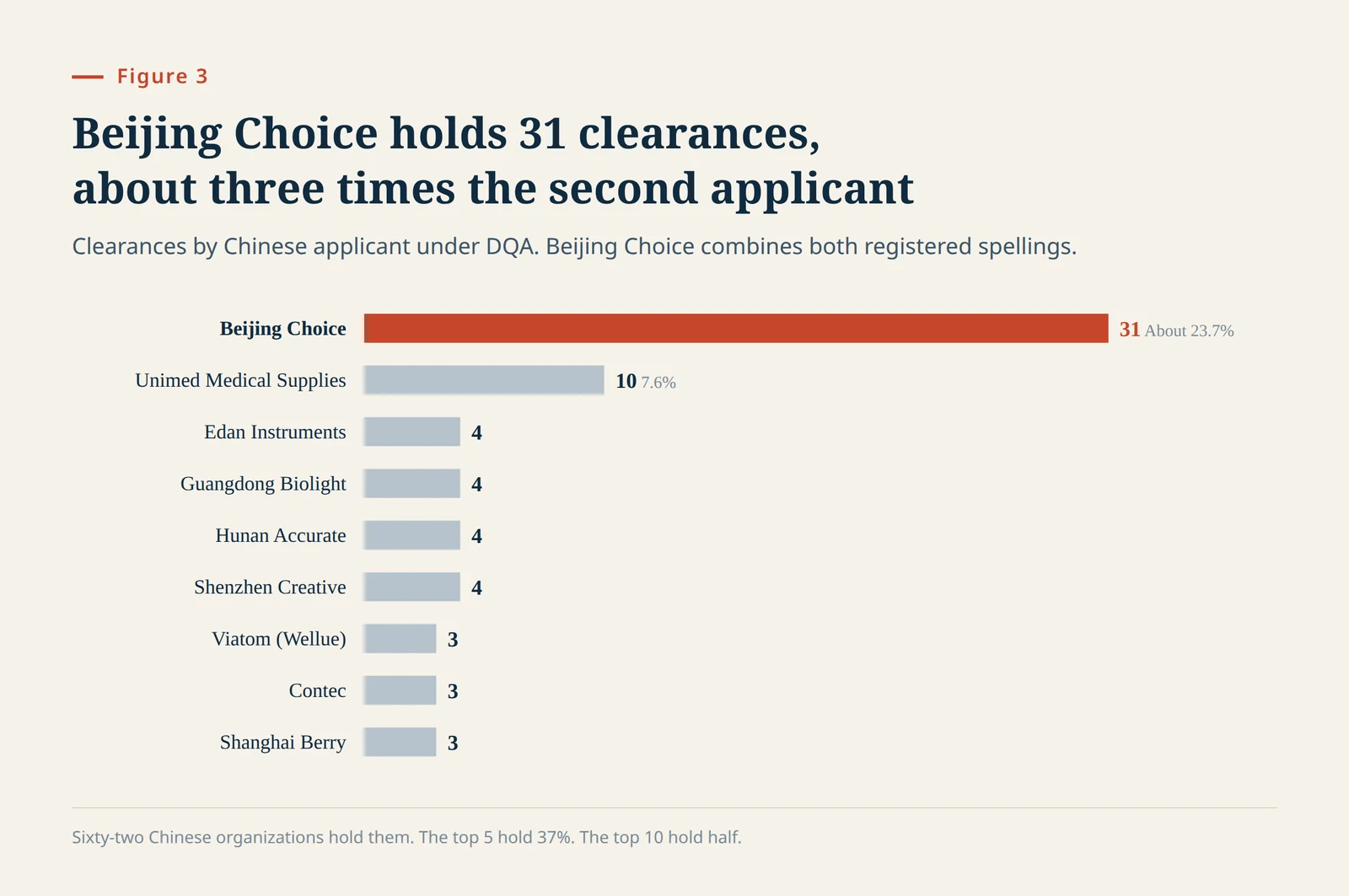
The FDA file spells the company two ways: "Beijing Choice Electronic Technololgy" and "Beijing Choice Electronic Technology." Early entries misspelled Technology by one letter. Together, Beijing Choice holds 31 clearances, about 23.7% of the Chinese total. Second is Unimed Medical Supplies, with 10, about a third of Beijing Choice's count.
| Applicant | Clearances | Share of the Chinese total |
|---|---|---|
| Beijing Choice (both registered spellings) | 31 | About 23.7% |
| Unimed Medical Supplies, Inc. | 10 | 7.6% |
| Edan Instruments, Inc. | 4 | 3.1% |
| Guangdong Biolight Meditech Co., Ltd. | 4 | 3.1% |
| Hunan Accurate Bio-Medical Technology Co., Ltd. | 4 | 3.1% |
| Shenzhen Creative Industry Co., Ltd. | 4 | 3.1% |
| Shenzhen Viatom Technology Co., Ltd. (Wellue) | 3 | 2.3% |
| Contec Medical System Co., Ltd. | 3 | 2.3% |
| Shanghai Berry Electronic Tech Co., Ltd. | 3 | 2.3% |
K072825 is the MD300I fingertip pulse oximeter. Over the following decade and more, Beijing Choice iterated the MD300 series and the CMS series and filled out models under the same code. Each new clearance needs a predicate. The predicate most readily available is often a model a leader has already cleared, so a dense set of clearances raises the cost of the next entry.
Viatom has only 3 clearances, and they are the newest shapes: the ring-style O2Ring, the wrist-worn Checkme O2, and the fingertip Oxyfit, the form factors home-use wearable oximetry has been moving toward. K242876, cleared on February 28, 2025, covers PO2, PO2A and PO2B. Biolight and Edan have 4 each. Their line is clinical monitoring, not only home fingertip devices.
Two different shares get mixed together. Market research firms often describe the pulse-oximeter market as led by Masimo, Nonin, Medtronic and Philips, with Chinese manufacturers at about 7% combined. That 7% is dollar revenue. Fingertip oximeters have a low unit price and a high unit volume, so Chinese manufacturers weigh more in units sold, and in clearance counts, than they do in revenue. The 18% and the "over half" are supply-side counts. They are not revenue shares.
What the code actually covers
DQA is an oximeter under 21 CFR 870.2700, Class II, cleared by 510(k). Section 870.2700 covers a wide set of principles, including reflectance, transmittance and fiber-optic designs. The great majority of products under the code are pulse oximeters worn on a fingertip, a wrist or an earlobe, estimating arterial oxygen saturation as SpO2.
The review is not in cardiovascular devices and not in radiology. DQA sits with the anesthesiology team, CDRH's OHT1/DHT1C, the group that also covers anesthesia monitoring and sleep-disordered breathing.
The application turns on a predicate chain. Beijing Choice's MD300 series has repeatedly used cleared Nonin Onyx models as predicates. Viatom's Checkme/O2 series later became the predicate for newer entrants, including Wesper (K213515). Chinese manufacturers first compared themselves with US devices, and later became the comparison for the next filer. A longer chain is what a mature code looks like.
ISO 80601-2-61 is the standard cited over and over. The second edition listed on the FDA classification page is from December 2017. Earlier clearances may also cite ISO 9919:2005, which has been replaced. Alongside those are IEC 60601-1, IEC 60601-1-2, and ISO 10993 for skin contact by the finger clip or the probe. A common accuracy bar is SpO2 Arms at or below 2% over the 70%–100% range, and pulse rate within 1 bpm.
Submission type sets the clock. A wholly new model, and a new applicant, go through Traditional. A small change to software, the display or the algorithm of a cleared model can use Special, which the FDA aims to finish within 30 days. Once a leader's main models are set, many derivatives go through Special. That is one reason a single code can accumulate dozens of clearances for the same company.
What the same facts mean for the people buying and competing
Hospitals and distributors. The clearance count says Chinese applicants are the majority of recent DQA records, concentrated in Beijing Choice, with a wearable group at Viatom and clinical monitors at Biolight and Edan. It does not say the device has been tested to the 2025 draft, and it does not say a patent leaves the product free to ship. Contec's 3 clearances and its stopped US sales are the example already on the record. If the FDA publishes the clinical-data list it has described, that list will be a buying signal the clearance database does not currently provide.
Brand owners using a Chinese design. The draft, if finalized along the lines published, moves a study from about 10 subjects and about 200 data points to at least 150 subjects and about 3,000 data points, with darker skin tones in proportion and skin tone recorded on the Monk scale and ITA. As of January 2026 that is not a requirement. The standards reviews already use are a separate, current list: ISO 80601-2-61, ISO 10993 including parts 5 and 10 for skin contact, and IEC 60601-1-2, fourth edition, for EMC. A predicate from the past 5 years, and of the same form, is what the source describes as less likely to draw extra questions. For a ring or other wearable, Viatom's Checkme/O2 series is a modern chain other filings already cite. ChoiceMMed's US patents are already a portfolio. Money spent on a clinical study does not answer the patent question. Contec is the case where the clearance and the right to sell came apart.
Competitors on the revenue side. Masimo, Nonin, Medtronic and Philips are the names research firms put at the top of dollar sales, with Chinese manufacturers at about 7% of revenue. On clearance counts the picture is the reverse of that revenue rank: over half of recent DQA clearances, 31 of them at one company. The draft raises the cost of the next new clearance and of a major change. It does not, on the text available, pull back clearances already granted. An existing holder can, under the draft's own transition, add clinical data and relabel without changing hardware or software, on a review the FDA generally puts inside 30 days.
The supply side of DQA is now largely Chinese applicants. The impression that a clearance is the hard part is what the draft and the Choice–Contec case both cut into. The clearance is still the entry. Clinical scale and patents are what sit after it.
Look it up on MedRegData
Registrations mentioned here can be searched in the MedRegData database. The links below open the matching results; the first few pages are visible without logging in.
About the data
The 726 DQA clearances, the 131 with a Chinese applicant, the year shares, the organization ranking and the Traditional/Special split are an aggregation of the FDA public 510(k) database through June 2026. Country is the applicant's country field. The draft guidance is the January 6, 2025 document. The occult-hypoxemia figures are Sjoding and colleagues, NEJM, December 17, 2020, and Valbuena and colleagues, BMJ, July 6, 2022, using Veterans Health Administration inpatient data from 2013 to 2019. The patent settlement is as reported by IP Fray for December 2024. STAT's January 12, 2026 report is the source for the state of the draft and the FDA-funded study in early 2026. The panel meeting was November 1, 2022.
- FDA draft guidance on pulse oximeters for medical purposes
- FDA product classification, DQA
- Sjoding and colleagues, NEJM, December 17, 2020
- IP Fray on the Beijing Choice and Contec settlement
- STAT, January 12, 2026
- Valbuena and colleagues, BMJ, July 6, 2022
- Federal Register notice of the draft guidance
- MedRegData, DQA clearances
- FDA 510(k) database