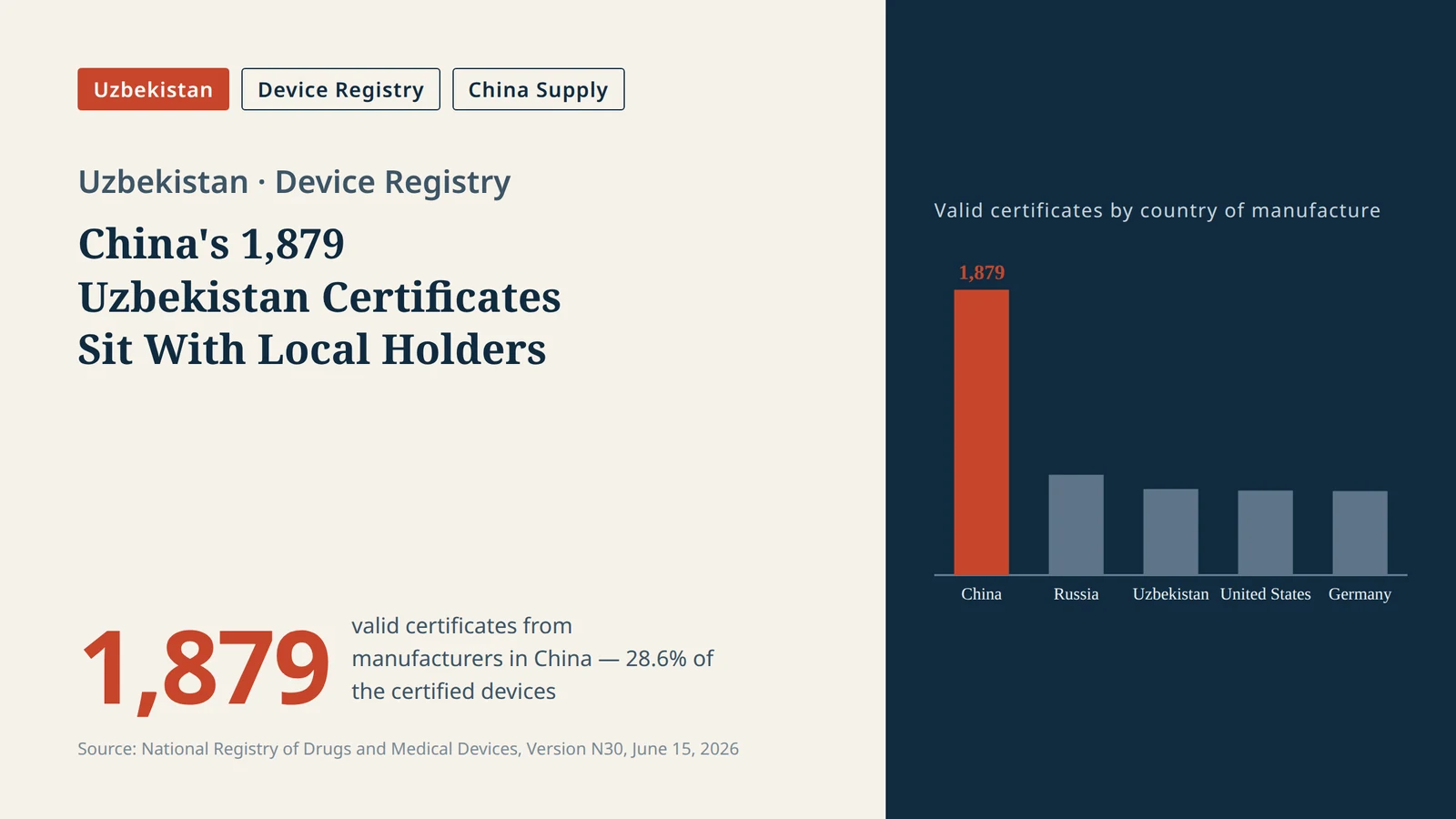
China's 1,879 Uzbekistan Certificates Sit With Local Holders
China is the largest source country in Uzbekistan's medical-device registry: 1,879 valid certificates, 28.6% of the certified devices. Mindray alone holds 187. Half of the ultrasound devices, and more than two-thirds of the MRI systems, come from manufacturers in China.
On this page
Search in MedRegData
China is the largest source country in Uzbekistan's medical-device registry: 1,879 valid certificates, 28.6% of the certified devices. Mindray alone holds 187. Half of the ultrasound devices, and more than two-thirds of the MRI systems, come from manufacturers in China.
Most of those certificates are not in the manufacturers' names. A foreign manufacturer cannot file on its own. The application goes through an authorized representative registered in Uzbekistan, and the certificate is issued in that representative's name. The products can be established in the market while the right to keep them there sits with someone else. For a buyer, a distributor, a brand owner, or a competitor, the count of certificates is the second question. The first is whose name is on them.
A smaller registry than the neighbors
Uzbekistan has more than 37 million people, the largest consumer market in Central Asia. Its own device industry is thin, and the country depends heavily on imports. Recent work to modernize the health system has brought more Chinese companies into devices and diagnostics.
The count is Version N30 of the National Registry of Drugs and Medical Devices, published by the Center for Safety of Pharmaceutical Products and updated on June 15, 2026. After drugs and pure chemical raw materials are taken out, 6,571 valid records remain for devices and in vitro diagnostics. Of those, 6,568 are active and 3 have been cancelled.
By category, equipment and consumables are 5,505 records, 83.8%: surgical instruments, monitors, imaging, injection and puncture consumables, and implants. In vitro diagnostics are 1,064 records, 16.2%: chemistry analyzers, immunoassay systems, molecular reagents, and rapid tests.
| Category | Valid certificates | Share |
|---|---|---|
| Medical equipment and supplies | 5,505 | 83.8% |
| In vitro diagnostics | 1,064 | 16.2% |
| Cancelled | 3 | 0.05% |
| Total | 6,571 | 100% |
At 6,571 entries the list is much smaller than the registries in Russia or Turkey. Fewer names are on it, and a single certificate weighs more. In a narrow category, a dozen certificates can be enough to lead.
Country names in the registry are in Russian. For this count, Китай and КНР were combined, Россия and РФ were combined, and Корея and Республика Корея were combined. That one merge removed about 5% of China's records that would otherwise have been left out. Manufacturer names were rolled up to the parent after fuzzy matching and a manual check, so capitalization and subsidiary suffixes did not split one company into several.
Where the 28.6% actually sits
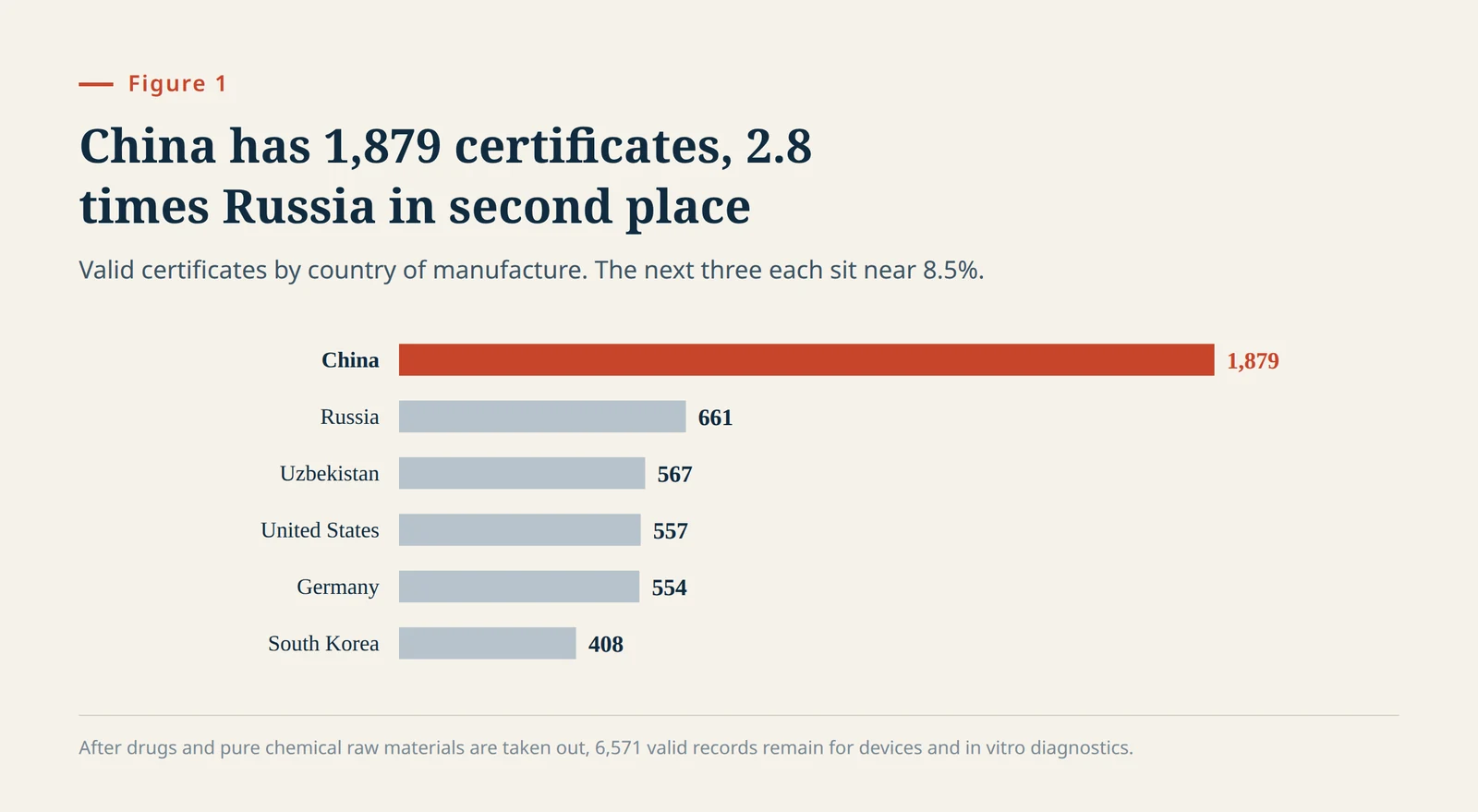
By country of manufacture, China is first with 1,879 certificates, almost 2.8 times Russia, second with 661. Then Uzbekistan with 567, the United States with 557, and Germany with 554. Those three each sit near 8.5%.
| Rank | Country of origin | Valid certificates | Share | Where the strength is |
|---|---|---|---|---|
| 1 | China | 1,879 | 28.6% | IVD reagents, monitors, ultrasound, consumables |
| 2 | Russia | 661 | 10.1% | Basic equipment, low-risk consumables, first-aid kits |
| 3 | Uzbekistan | 567 | 8.6% | Syringes, cotton swabs, gauze, basic infusion tubing |
| 4 | United States | 557 | 8.5% | High-value implants, ophthalmic equipment, precision analyzers |
| 5 | Germany | 554 | 8.4% | Large imaging, surgical instruments, endoscopes |
| 6 | South Korea | 408 | 6.2% | Dental implants, clinical chemistry, ultrasound |
| 7 | India | 246 | 3.7% | Basic surgical instruments, disposable consumables |
| 8 | Italy | 222 | 3.4% | Dental treatment units, orthopedic implants |
| 9 | Japan | 200 | 3.0% | Electronic endoscopes, hematology analyzers, precision monitoring |
| 10 | Turkey | 121 | 1.8% | Hospital furniture, sterilization, disposable consumables |
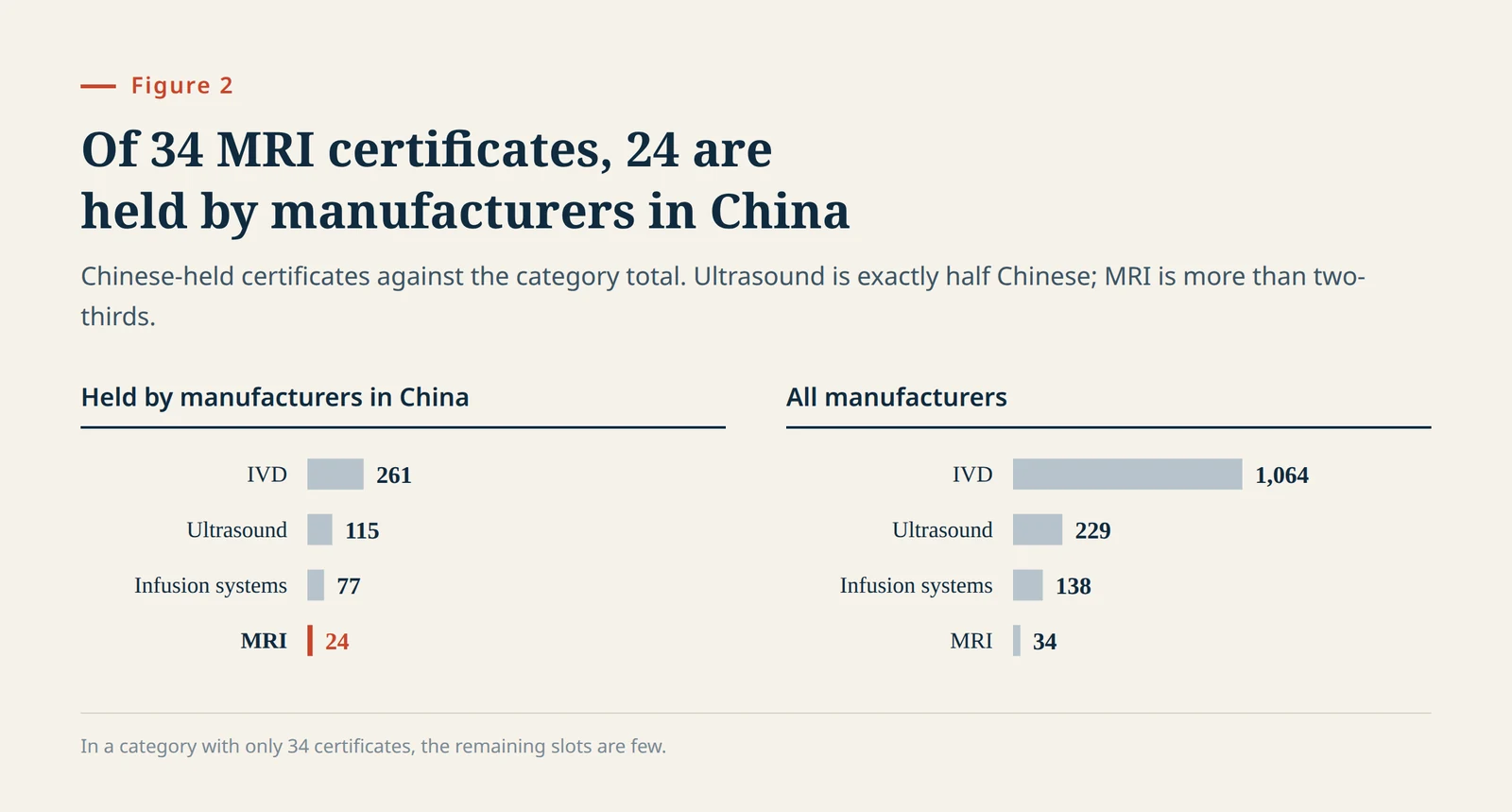
The 28.6% is not spread evenly across categories. In vitro diagnostics is the deepest block. Of 1,064 IVD registrations, companies from China hold 261. Within that, diagnostic reagents and test kits tied to reagents and rapid tests account for 230. Immunoassay reagents and rapid kits from Wondfo, Assure Tech, and Genrui are in larger local laboratories and in primary-care networks. On some infectious-disease screening items, the number of certificates exceeds Roche's 45 and Siemens's 71. That is not one or two hero products. It is a set of rapid kits plus low-cost analyzers, which fits what a primary hospital can buy.
On large equipment the concentration is higher. Products whose names match an ultrasound keyword total 229, and Chinese brands hold 115, exactly half. The certificate holders are Mindray, SonoScape (17), Vinno (13), and Chison (12). Infusion and fluid-delivery systems total 138, of which 77 are made in China, mostly disposable precision infusion sets, syringe pumps, and indwelling needles. Magnetic resonance is a short list: 34 products, 24 of them from Chinese manufacturers, mainly Beijing Wandong and Mindray. In a category with only 34 certificates, the remaining slots are few.
What it means for a buyer: an ultrasound, an infusion set, or an MRI system on a Uzbek tender is more likely to be from a manufacturer in China than from anywhere else. A high-value implant, an endoscope, or a dental implant is more likely to be from the United States, Germany, Japan, Korea, or Italy. The 28.6% is a category fact, not a blanket one.
Mindray's 187, and a long drop to the next name
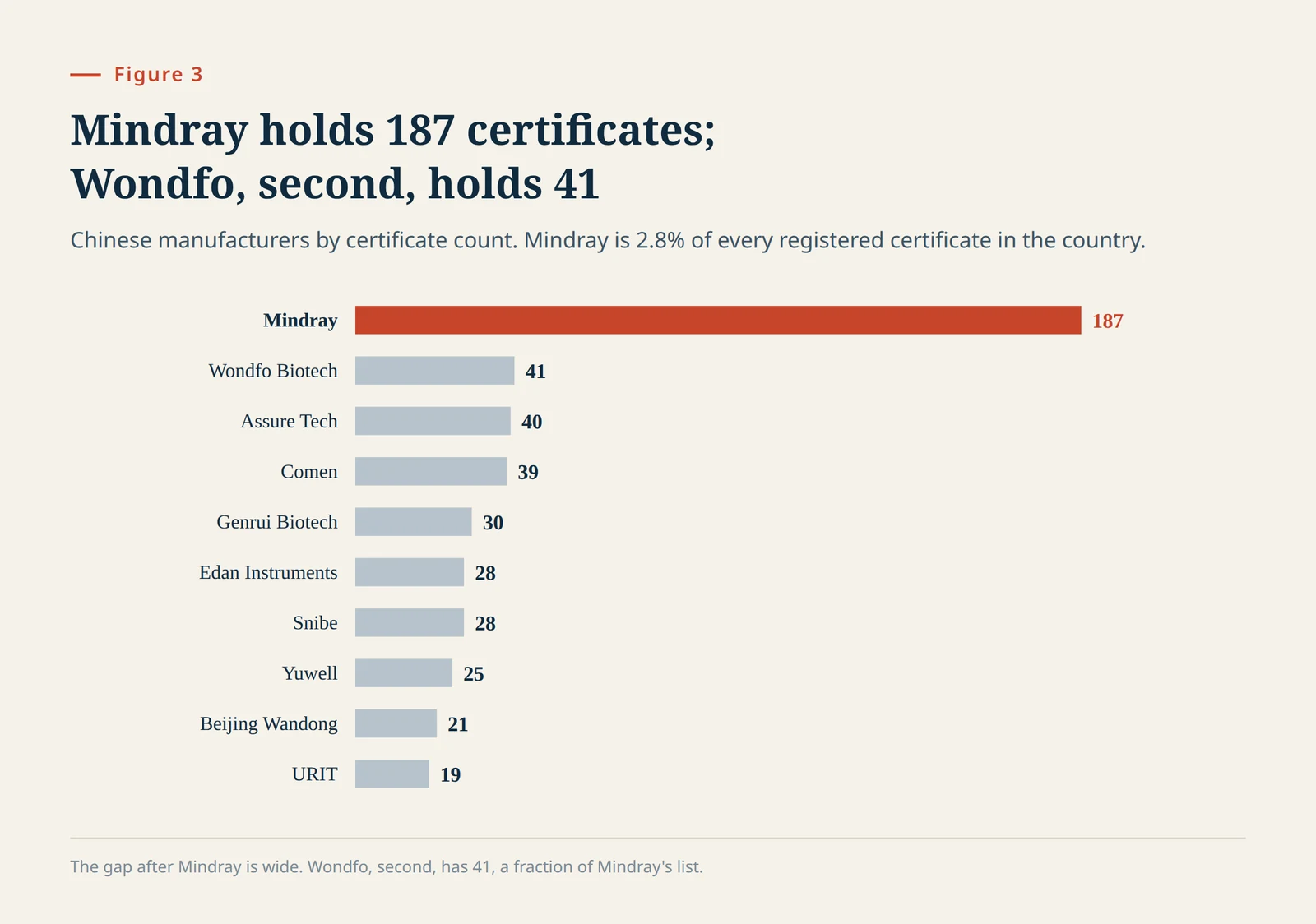
Grouped by manufacturer, the 1,879 Chinese certificates have one clear leader. Shenzhen Mindray is the largest single foreign manufacturer in Uzbekistan by certificate count: 187, which is 2.8% of every registered certificate in the country. Imaging, monitoring and life support, and IVD each have a local set.
| Manufacturer | Certificates | Core products |
|---|---|---|
| Mindray | 187 | Imaging, monitoring and life support, IVD |
| Wondfo Biotech | 41 | POCT and immunoassay reagents |
| Assure Tech | 40 | Rapid test kits |
| Comen | 39 | Monitors, anesthesia machines, infant care |
| Genrui Biotech | 30 | Small and mid-size chemistry and hematology analyzers, and their reagents |
| Edan Instruments | 28 | ECG, obstetric monitoring, ultrasound |
| Snibe | 28 | Chemiluminescence analyzers and immunoassay reagents |
| Yuwell | 25 | Oxygen concentrators, blood-pressure monitors, basic wheelchair supplies |
| Beijing Wandong | 21 | X-ray systems and MRI |
| URIT | 19 | Urine analysis and hematology reagents |
The gap after Mindray is wide. Wondfo, second, has 41, a fraction of Mindray's list. China's share is one leader plus a set of mid-size manufacturers, each in a niche. Ultrasound and rapid test kits, the two busiest categories, are already filled by the names above.
What it means if you compete with them: a new certificate in basic ultrasound or in rapid tests is a certificate in a category Mindray, Wondfo, or Assure Tech already occupies. It is not an empty field.
How a certificate is actually obtained
Devices and IVD reagents are reviewed by the Center for Safety of Pharmaceutical Products, under the Ministry of Health, at uzpharm-control.uz. The center was previously the State Agency for Pharmaceutical Development. After several reorganizations it handles national registration, standards, laboratory testing, and approval for drugs, devices, and IVDs, and it runs several national testing laboratories. A device entering from abroad for the first time usually faces sample testing or an on-site look at the quality system.
The legal base is the Law on Pharmaceutical and Medicinal Activities, on the official database lex.uz. Devices and IVD reagents used for clinical diagnosis, prevention, or treatment need a national registration certificate before they can be imported, sold, or used. The procedure sits in the Regulations on the Registration and Re-registration of Medical Devices and Medical Technologies, issued by a Cabinet of Ministers decree. Risk runs in four classes: Class I low, Class IIa medium-low, Class IIb medium-high, Class III high, on lines generally consistent with the EU MDD and MDR. Compliance documents have to be in Uzbek or Russian.
A foreign manufacturer cannot file with the center directly. It appoints an authorized representative with legal status in Uzbekistan, and that representative files. The path has five parts.
Documents and translation. The technical file, the ISO 13485 certificate, the declaration of conformity, the instructions, and the free-sale certificate are assembled and translated into Russian or Uzbek. Some documents need Hague certification or consular authentication.
Filing and a completeness check. The representative submits the electronic and paper packages. The center checks that the file is complete within 10 working days, then issues a payment notice.
Samples and a technical review. For Class II and Class III devices, official laboratories usually require samples and run chemical, toxicological, electrical-safety, and electromagnetic-compatibility tests. Particularly high-risk devices may also need a small clinical trial or a validation at a designated institution in Uzbekistan.
A factory audit, in reserve. For some Class III implants, the center keeps the right to audit the manufacturing site for GMP.
The certificate. If the review passes, the center issues a national registration certificate and the product goes into the national database.
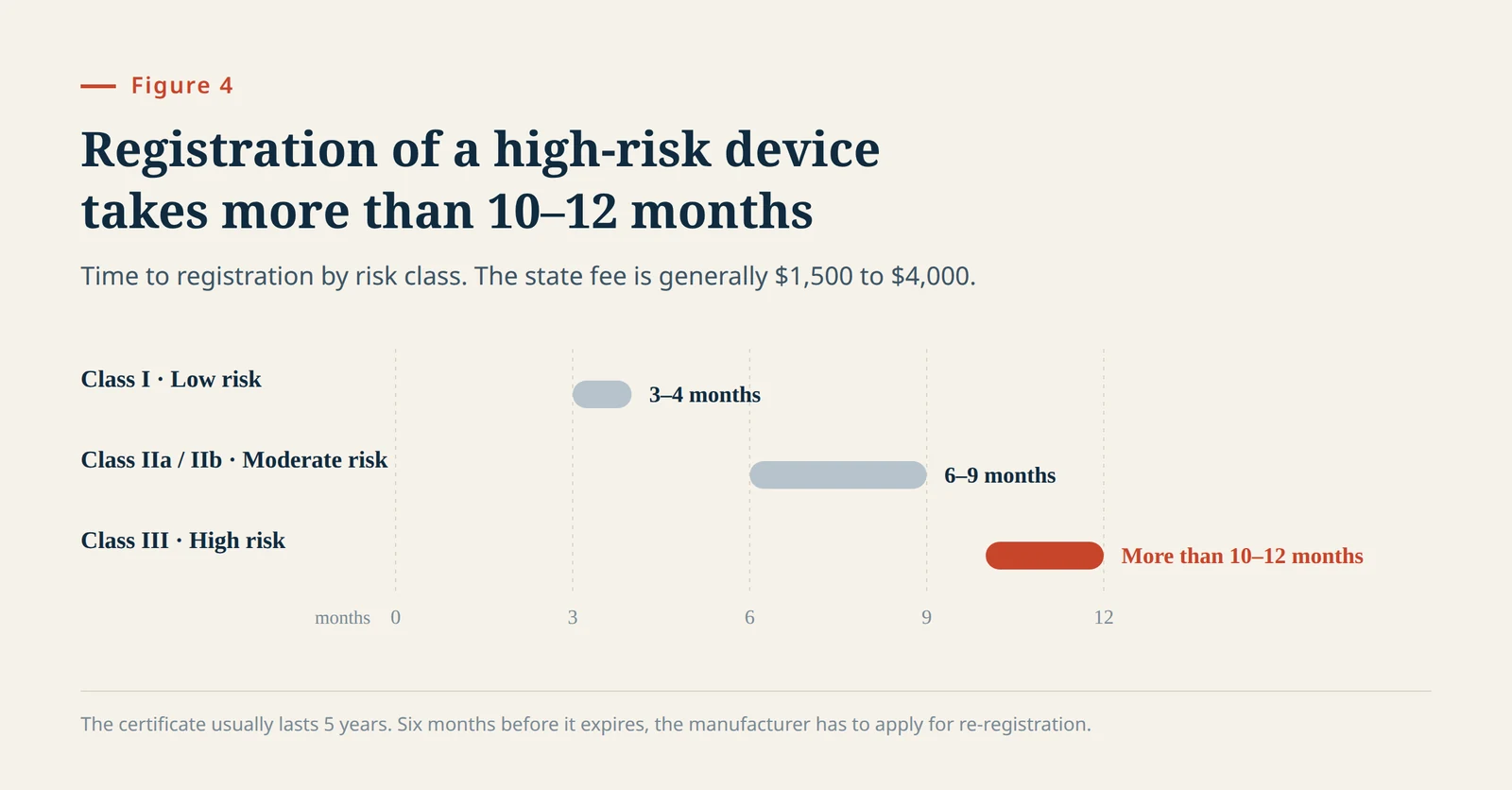
Time and cost follow the class:
| Class I, low risk | Class IIa / IIb, moderate risk | Class III, high risk or implantable | |
|---|---|---|---|
| Typical products | Manual wheelchair, basic examination gloves | Electronic blood-pressure monitors, diagnostic ultrasound | Orthopedic implants, artificial joints, heart stents |
| Time | 3–4 months | 6–9 months | More than 10–12 months |
| Sample testing | Usually waived | Local testing is required; samples must be sent | Mandatory; some products also need clinical validation |
| Factory inspection | Waived | Usually waived | The authority reserves an on-site GMP inspection |
| Validity | 5 years | 5 years | 5 years |
The state fee is generally $1,500 to $4,000, depending on class and on which tests are ordered. That figure does not include the local representative, notarization and translation, or the cost of sending samples. The certificate usually lasts 5 years. Six months before it expires, the manufacturer has to apply for re-registration through the local representative. Miss that date and, once the certificate is dead, the product starts again as a new registration.
An EAEU certificate does not open this market
A common assumption in the CIS trade is that one Eurasian Economic Union device registration sells the product in Uzbekistan. It does not. Uzbekistan is an observer in the union, not a member, and it does not take part in the union's common device-registration rules. A certificate from Russia, Kazakhstan, or Belarus does not by itself authorize sale in Uzbekistan.
Those records are not useless in the review. The center accepts registration records from Russia's Roszdravnadzor, and Kazakhstan's national test records, as reference material. A product already registered in Russia or Kazakhstan, with a complete Russian technical file and toxicology reports, can be submitted as support and can shorten the technical review. Local testing is still required. Samples are still sent, and the tests are still run.
What it means for a distributor: a warehouse cleared for Kazakhstan is not a warehouse cleared for Uzbekistan. The Russian file can shorten the review. It does not replace the local certificate or the local samples.
Where the list is not already full
Chinese-made products are 28.6% of the registry, and Mindray and Wondfo are heavily concentrated in ultrasound and rapid tests. Another Chinese certificate in those two lines is competing with holders who already occupy them.
Three areas are where those leaders have not locked the list.
Dental implants and higher-value oral consumables. The local dental market is led by the Korean brand Osstem, with 25 registrations, and by Italian brands. Lower-priced Chinese implants and orthodontic devices are the opening the registry still shows.
Rehabilitation and physical therapy. As the population ages and rehabilitation demand grows, low-risk physical-therapy devices and rehabilitation aids — the source describes them as higher-margin — have few registered competitors.
Precision minimally invasive and interventional consumables, such as guidewires and electrophysiology catheters. Lifetech, Shenzhen, already holds 15 registrations. The path described is price and channel terms against German, US, and Japanese brands.
The channel term that decides the rest is separate from the product. In Uzbekistan the name on the license is usually the local representative. A contract that only appoints that representative does not, by itself, keep the certificate with the manufacturer. The ownership has to be written down: the representative files, the manufacturer owns the registration, and a commercial dispute does not let the representative block a change of agent. Giving both an exclusive representation and an exclusive distributorship to the same small or mid-size importer puts the certificate and the sales in one pair of hands. The alternative in use is an independent consultancy as the named representative, with room to appoint more than one distributor. If the relationship breaks, the name on the license is who can keep selling.
Look it up on MedRegData
Registrations mentioned here can be searched by country in the MedRegData database. The links below open the matching results; the first few pages are visible without logging in.
Sources
The base is Version N30 of the national registry, updated June 15, 2026. The country and manufacturer figures keep medical devices and in vitro diagnostic devices. Active pharmaceutical ingredients, finished drugs, and cancelled records were set aside for that cut. Country names are stored in Cyrillic; Китай was combined with КНР, Россия with РФ, and Корея with Республика Корея.
- Center for Safety of Pharmaceutical Products: https://uzpharm-control.uz
- National legal database, including the Law on Pharmaceutical and Medicinal Activities and the Cabinet rules on device registration: https://lex.uz
- Ministry of Health, on health-system modernization, public-hospital tenders, and device policy: https://ssv.uz